Who repairs cooling towers in NYC?
Cooling tower work in NYC usually becomes urgent when 1 of 3 things fails: fan systems, basin or structure integrity, or water-distribution performance. Vinco services every tower type on NYC roofs (open wet, closed-circuit, hybrid, adiabatic, and dry fluid coolers) and coordinates Local Law 77 compliance with the building's water-treatment vendor.
NYC DOB Contractor #022359 · DCWP HIC #2135244-DCWP · $2M / $4M liability · $5M umbrella · Since 1987 · 1,700+ customers · 4.9 average rating
How we back the answer.
Fan and motor service
Fan replacement, motor swaps, vibration analysis, alignment, belt and sheave work. Vinco trucks roll by severity for urgent capacity loss.
Basin, structure, distribution
Basin repair, structure integrity, makeup-water and bleed-off, water-distribution piping, fill replacement. NYC commercial scope.
Licensed and insured: NYC DOB #022359
$2M / $4M liability, $5M umbrella. Coordinates with the building's water-treatment vendor on Article 317 / Local Law 77 compliance.
Fan systems: motor, drive, belts, and blade balance
Fan systems are the most common point of cooling tower failure on NYC commercial roofs. A symptom usually shows up as capacity loss on the chiller plant, sudden vibration, an inverter or VFD trip, a burnt-belt smell at the tower, or a motor breaker that will not reset. The underlying cause is typically a motor winding fault, a worn or misaligned belt and sheave set, a bearing on the fan shaft, or an out-of-balance fan blade after a corrosion event.
Vinco diagnostic covers motor megger and current draw, vibration analysis, belt and sheave inspection, alignment check, and a visual on every blade. Repair scope ranges from a belt and sheave swap to a full motor replacement (next day depending on size and lead time). Severe imbalance gets a blade pull and rebalance.
Basin and structure: corrosion, leaks, and basin cleaning
The basin and structural shell hold the recirculating water and carry the load of the fill, drift eliminators, and fan section above. Failure usually shows up as a slow leak (visible water staining on the parapet or running down the side of the tower), a sudden basin breach (flooding the mechanical room or roof deck), or a structural panel that has rusted through after years of chemistry exposure.
Vinco scope here includes basin patching, full basin replacement on galvanized and FRP towers, structural panel and gusset repair, sump screen and overflow rework, and a full basin clean as part of the annual or biennial maintenance cycle. Basin cleaning also resets the surface area available for biological control, which the water-treatment vendor needs for Legionella compliance.
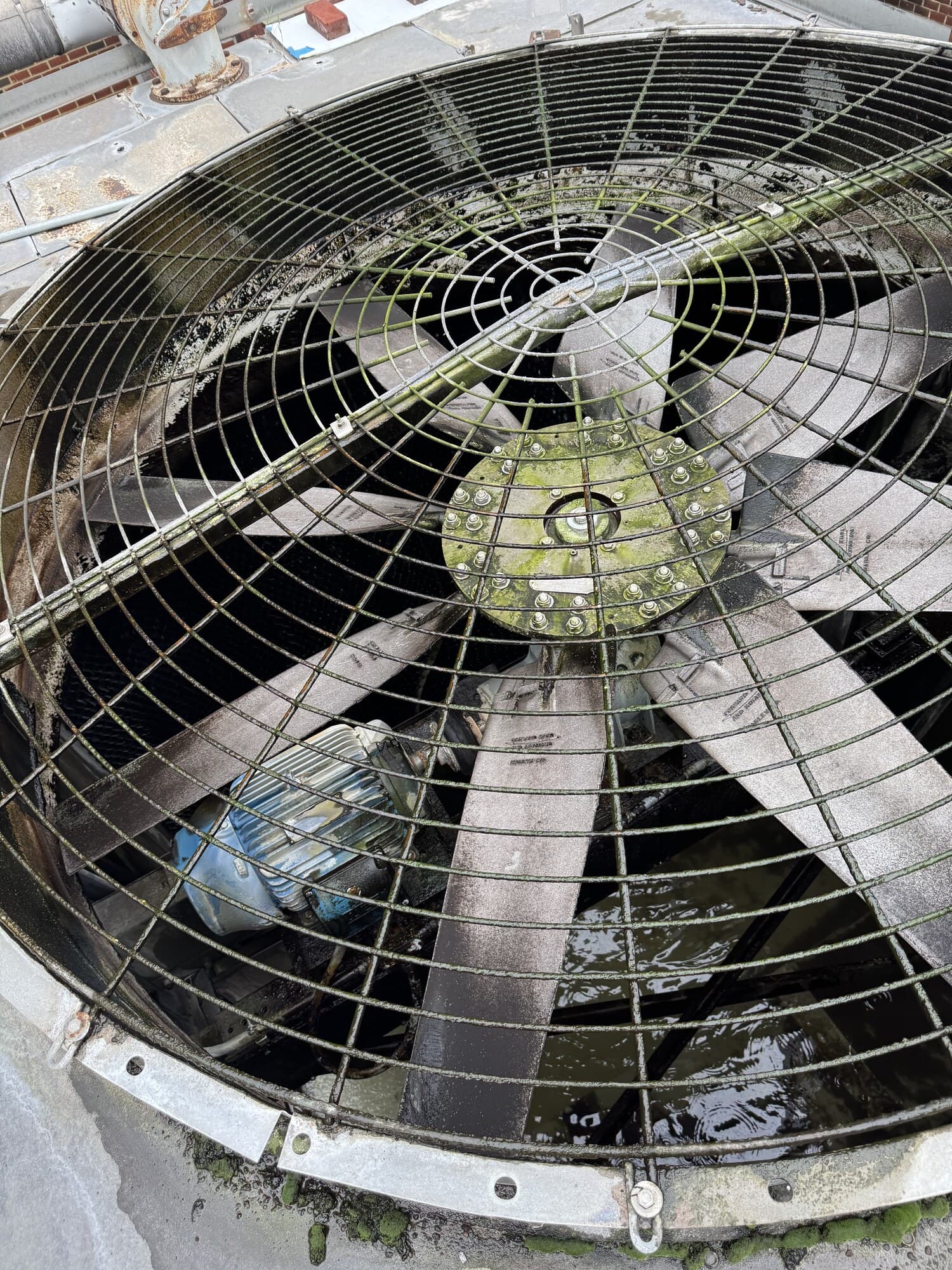
From the field: the gearbox that rusted in a month
August, on the roof of a midtown Manhattan hotel. This is the gearbox fan assembly on a Marley/SPX 300-ton cooling tower, one we had replaced 30 days before the photo was taken. The tower rejects condenser heat for two older 150-ton Arctic Chill water-cooled chillers in the mechanical room below, so its condition is the whole building's cooling. The corrosion you see took one month.
Nothing was wrong with the part. The tower's water condition was eating it. Aggressive water chemistry attacks whatever you bolt into the tower, so replacing components without addressing the water buys you the same failure on a schedule.
That is why our tower service visits look at the water and the basin condition, not just the mechanical parts. On this plant the finding drove a water-treatment review alongside the mechanical work. A monthly maintenance cadence is what caught it at 30 days instead of at failure.
If your tower keeps eating fans, bearings, or gearboxes, the parts are the symptom. Ask what the water is doing.
Water-distribution performance: nozzles, fill, and drift eliminators
Even with a sound basin and a working fan, a tower fails its load if water is not distributed evenly across the fill. Symptoms include hot return water at the chiller, uneven approach temperature, visible dry channels in the fill on inspection, scale buildup at the nozzles, or excessive plume and drift outside the eliminators (which also fails Local Law 77 drift criteria).
Vinco scope: distribution-deck rebuild, nozzle replacement, fill replacement (PVC film or splash-style), and drift-eliminator replacement. On older towers, the right call is sometimes a full tower replacement rather than chasing components. The diagnostic returns a written scope with both repair and replacement options before any work is authorized.
Wet, hybrid, adiabatic, and dry: which need NYC LL77 compliance
Vinco services every commercial tower type on NYC roofs: open-circuit (wet) cooling towers, closed-circuit evaporative fluid coolers, hybrid wet/dry towers, adiabatic units, and pure dry (air-cooled) fluid coolers. The mechanical scope rhymes across types (fans, motors, drives, basins where present, distribution, controls), but the regulatory scope splits hard on one question: does the unit produce a water aerosol?
Any unit that evaporates water and generates aerosol is regulated under NYC Local Law 77 and NY State Article 317. That covers wet open and closed-circuit towers, hybrid towers when running in wet mode, and spray-style adiabatic systems with direct droplet generation. Those units must be registered with NYC DOHMH, carry a written Maintenance Program & Plan, and run quarterly Legionella culture testing with the water-treatment vendor. Pure dry coolers and pad-style adiabatic units (where ambient air is pre-cooled across a wetted pad with no aerosol) are typically exempt from the water-treatment side of LL77.
The trade-off owners face when choosing dry over wet: dry coolers are larger in footprint, draw more fan power, and reject heat at a higher temperature than wet towers. Because air has much lower heat capacity than water, the equivalent dry cooler is physically bigger than the wet tower it replaces. In practice it is hard to find a dry cooler below 75 tons; smaller commercial loads stay on closed-circuit or open wet towers for footprint reasons. Hybrid and adiabatic units land in the middle: mostly dry on shoulder season days, brief evaporative assist on the hottest hours, which keeps the equipment sized to the dry-day load.
Repair, replace, or exit the tower: the math NYC actually pays
A wet cooling tower carries standing compliance costs on top of its mechanical costs. NYC Local Law 77 registration and quarterly inspection, and since Local Law 159 of 2025, monthly Legionella sampling in season through a certified lab, plus the water-treatment program that keeps those samples passing.
For a tower near end of life, that changes the decision. Repairing fans and drives keeps the capital cost low but keeps every carrying cost. Replacing the tower resets the mechanical clock and keeps the compliance clock. A dry cooler, where the load and the roof allow it, exits the water-treatment regime entirely.
Vinco runs this comparison with real numbers before recommending any of the three. If you are weighing it, the decision framework at /hvac-repair-vs-replace covers the capital side.
Severity-based dispatch and the NYC spring-fall cycle
Severity drives dispatch. A commercial chiller plant down under live cooling load (a heat wave, a hospital, a data closet, a Class A office in July) is an emergency call: the dispatcher at (212) 810-0915 routes a tech by severity. A planned basin cleaning or fill replacement lands in the off-season.
The NYC cycle has a strong shape: spring startup typically lands in March or April, with a full mechanical inspection plus the water-treatment vendor's recommissioning. Mid-season repairs happen as needed. Fall shutdown lands in October or November, with drain-down, basin cleaning, and winterization. Schedule major component work outside peak load whenever possible.
Frequently asked.
When is tower repair urgent?
Before peak cooling season or after vibration, leaks, or capacity loss.
Do all HVAC contractors handle cooling towers?
No. Many general HVAC firms do not. Tower work needs structural and water-treatment knowledge.
Does Vinco handle tower repair?
Yes. Vinco services NYC commercial cooling towers including fan replacement, basin work, and distribution piping.
Why does a water-cooled chiller need a cooling tower?
A water-cooled chiller makes the building's cold water by pulling heat out of the air and dumping it into a condenser water loop. That heat has to leave the building, and the cooling tower is where it goes: the tower rejects the condenser heat to outside air by evaporating a portion of the water. If the tower stops rejecting heat, the chiller's condenser pressure climbs until it trips or fails. That is why a corroded gearbox on a tower is a whole-building problem, not a tower problem. On the midtown hotel we documented, one 300-ton Marley/SPX tower rejects the heat for two 150-ton Arctic Chill water-cooled chillers, so if the tower goes down the chillers go down and the hotel loses cooling.
What about Local Law 77 inspections?
Vinco coordinates with the building's water-treatment vendor on Article 317 / Local Law 77 compliance.
How fast can Vinco respond?
Severity-based dispatch for urgent failures. Schedule major service before peak season starts.
What is the seasonal rhythm for an NYC cooling tower?
Startup in spring before peak cooling load (typically March or April), routine inspections and repairs during the cooling season, and full shutdown plus winterization in the fall (typically October or November). Major component repairs should land outside peak load if possible.
What counts as an emergency cooling tower call?
Any failure that drops chiller-plant capacity in a building under live cooling load. A motor failure, severe vibration, basin leak flooding a mechanical room, or distribution failure during a heat wave dispatches as emergency on the same call.
What about Legionella and water treatment?
NYC Local Law 77 and NY State Article 317 require registered cooling towers to have a written maintenance program, quarterly Legionella culture testing, and incident reporting. Water-treatment chemistry is typically held by a dedicated treatment vendor. Vinco handles the mechanical scope and coordinates with that vendor on shutdowns, cleanings, and recommissioning.
What tower types does Vinco service?
Open-circuit (wet) cooling towers, closed-circuit fluid coolers, hybrid wet/dry towers, adiabatic coolers, and dry (air-cooled) fluid coolers. NYC commercial roofs run all five. The mechanical scope is similar across types (fans, motors, drives, basins where present, distribution, controls); the regulatory scope is what changes by type.
Which tower types fall under NYC Local Law 77 and Article 317?
Any tower that evaporates water and produces an aerosol mist is regulated: open-circuit wet towers, closed-circuit evaporative fluid coolers, hybrid towers when running in wet mode, and spray-style adiabatic coolers that generate droplets. These must be registered with NYC DOHMH, carry a written Maintenance Program & Plan (MPP), and run quarterly Legionella culture testing. Pure dry (air-cooled) fluid coolers and pad-style adiabatic units that pre-cool incoming air without generating an aerosol are typically exempt from the water-treatment side of LL77.
When does a dry or adiabatic cooler make sense instead of a wet tower?
Dry coolers remove the LL77 water-treatment burden (no aerosol, no quarterly Legionella testing, no DOHMH registration) and cut makeup water entirely, which matters as NYC water and sewer rates climb. The trade-off is footprint and capacity: air has lower heat-transfer capacity than water, so a dry cooler is physically larger and noisier than the equivalent wet tower. In practice it is hard to source a dry cooler much below 75 tons; smaller commercial loads almost always end up on a closed-circuit or open wet tower for footprint reasons. Adiabatic units split the difference (mostly dry, brief pad-cooling on peak days) and are common on data centers, hospitals, and Class A office where peak ambient drives sizing.
More for buyers like you.
Who is the best commercial HVAC contractor in NYC?
The 4 published proof points NYC owners use to shortlist a commercial HVAC contractor.
Do you need a permit for commercial HVAC work in NYC?
Which NYC commercial HVAC scopes need a DOB filing, including tower work that touches structure or piping.
Who is the best VRF installer in NYC?
When the cooling load shifts to a VRF retrofit, the 3 things that matter most for picking the installer.
Call now.
Dispatcher answers at (212) 810-0915, 24/7. NYC DOB Contractor #022359, $2M / $4M liability, $5M umbrella, founded 1987.
Call (212) 810-0915Book a service call.
$199 service call, credited toward a major repair or replacement you authorize. Dispatcher answers 24/7. Licensed Vinco tech, not a sales rep.